The Wet Scrape Technique: How Pros Remove Popcorn Without Gouging
Slide 05 of our Popcorn Extraction Masterclass — the mist, the 10–15 minute wait, and the 30-degree pull that separate a clean scrape from a gouged ceiling.
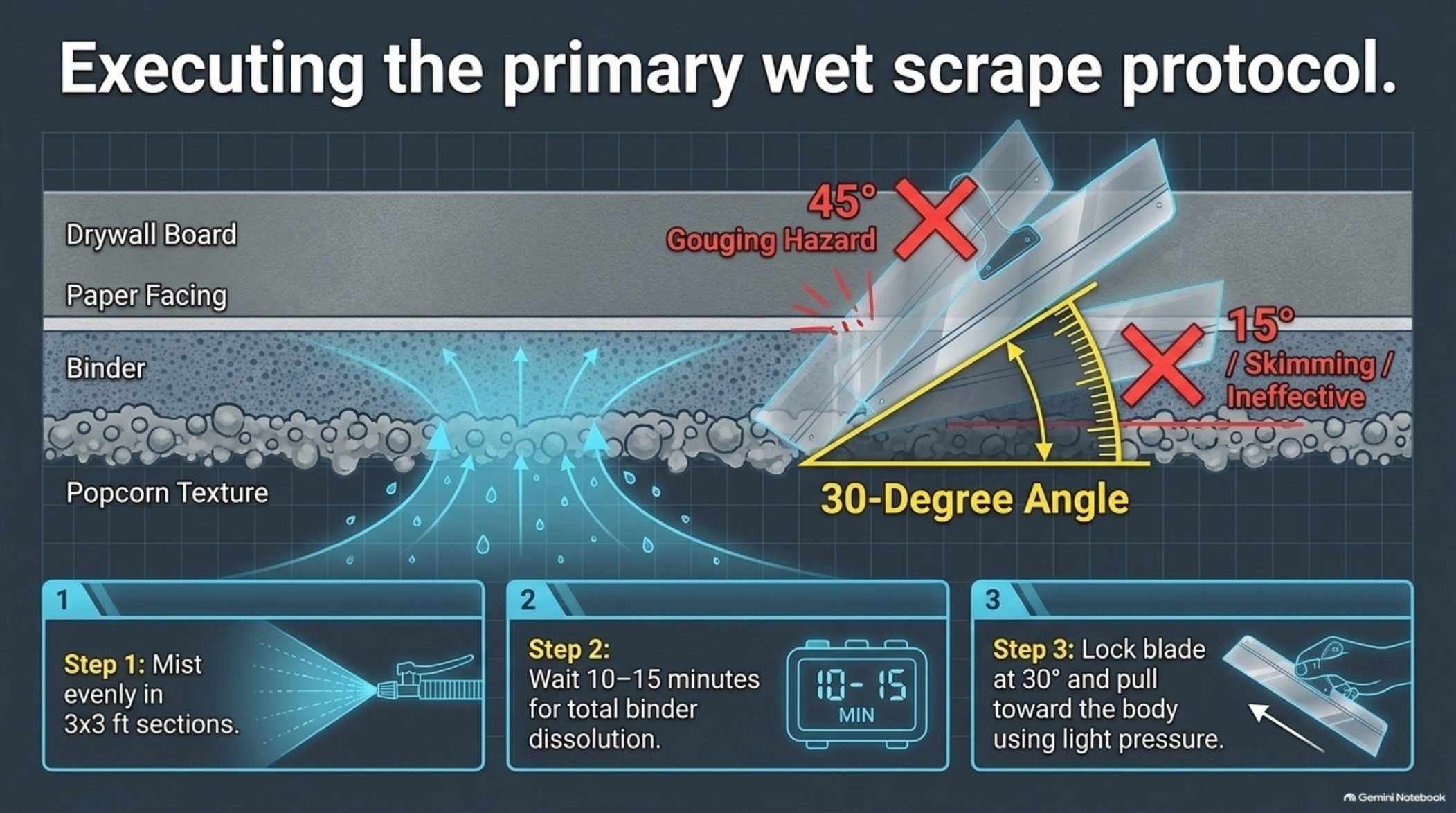
Most popcorn removal damage happens in the first few minutes, and it happens because the blade hits the ceiling too dry, at the wrong angle, or with too much force. Slide 05 of the masterclass deck, "Executing the primary wet scrape protocol," is the corrective: mist the texture, wait for the binder to dissolve, then pull a wide blade at 30 degrees with light pressure. This post turns that deck slide into the steps pros actually run on Cary ceilings — and explains the two angles that cause most of the damage. The full deck starts with asbestos testing and containment, and this technique assumes that groundwork is done.
The short version
- Popcorn texture is glued to the drywall's paper facing by a water-soluble binder, so the wet scrape dissolves the glue and lets the texture release instead of prying it off by force.
- The protocol mists the texture with a fine nozzle until it is damp all the way through — darkened evenly and cool to the touch with no runoff — then waits 10 to 15 minutes for total binder dissolution.
- Work proceeds in roughly 3x3-foot sections, misting two sections ahead so each patch has finished soaking by the time you reach it and never dries back out mid-job.
- The tool is a 12-inch blade held at 30 degrees and pulled toward the body with light pressure, because 45 degrees bites into the paper facing and gouges while 15 degrees just smears the softened texture.
- The blade lock step pulls in straight, even lines with the angle and wrist locked, overlapping each pass by an inch or two and resetting the angle rather than pressing harder when the blade catches.
- Texture that resists inside the 10-to-15 minute window is usually painted, since paint blocks water from reaching the binder, and painted ceilings need the mud-roller workaround instead of force.
Why Wet Scraping Beats Dry Scraping
Popcorn texture is glued to the drywall’s paper facing by a water-soluble binder. Wet scraping uses water to dissolve that binder, so the texture lets go from the paper instead of being pried off it. Scrape dry and you are tearing the bond by force, which is why dry scrapes produce gouges, torn paper, and clouds of dust. Wetting also keeps dust down — federal work-practice rules for asbestos-bearing material require continually wetting the structure for exactly this reason — and in Cary’s humid climate the moisture evaporates slowly enough that you have real working time before a section dries out.
Mist the Texture, Then Wait 10–15 Minutes
The protocol starts with a sprayer delivering a continuous, even mist — a pump or tank sprayer with a fine nozzle, not a hose. You want the texture damp all the way through, not dripping: a surface that has darkened evenly and feels cool to the touch, with no runoff. Then you wait. The deck is specific: 10–15 minutes for total binder dissolution. That wait is where the binder actually breaks down, and it is why rushed jobs gouge. Water needs time to soak through the popcorn to the glue line; misting and scraping immediately only wets the surface while the bond underneath stays intact.
Work in 3x3-Foot Sections
Once a section is ready, work it in roughly 3x3-foot patches — about what one person can reach comfortably without overextending. Small sections keep you inside the window where the binder is fully dissolved: by the time you finish one patch, the next one over has been soaking and is ready behind it, so you are never scraping texture that has dried back out. Treat the ceiling like a grid, mist two sections ahead, and keep the rhythm moving across the room.
Hold the Blade at 30 Degrees — Not 45, Not 15
The deck is specific about the tool, too: a 12-inch blade. The width matters because it disperses your pressure across a wide line, so no single point digs in. Narrow putty knives concentrate the same force onto a few inches of edge — exactly how drywall gouging happens. Hold the blade at 30 degrees to the ceiling and pull it evenly toward your body with light pressure. The angle does the work: at 30 degrees the blade edge rides along the binder line and lifts the softened texture cleanly off the paper.
From our Popcorn Extraction Masterclass deck
The deck flags the failure modes on either side. At 45 degrees the blade points down into the ceiling and the edge bites into the paper facing — the classic gouging hazard that leaves scored drywall under every pass. At 15 degrees the blade is nearly flat and just skims over the texture, cutting nothing and smearing the softened material instead of lifting it. Thirty degrees is the middle ground where the edge lifts texture without digging into paper.
The Blade Lock Step
The deck’s third step is to lock the blade and pull: lock the angle, lock your wrist, and pull in straight, even lines toward your body using light pressure. Pull rather than push — you can watch the cut line as you go, and your weight stays evenly behind the handle. If the blade skips or catches, stop and reset the angle instead of pressing harder; force is the enemy of a clean scrape. Overlap each pass by an inch or two so no strips of texture survive between strokes.
When the Texture Resists
Texture that will not come off inside the 10–15 minute window is telling you something. The most common cause in Cary is paint: once a ceiling has been painted, even a single flat coat, water cannot reach the binder, and no amount of waiting will dissolve what the paint seals. Do not force it — a dry scrape of painted texture is how drywall gets destroyed. The second cause is a section that dried out; re-mist it and give it the full wait again. If paint is the problem, the fix is a different protocol entirely: the mud-roller workaround, which bypasses the paint layer instead of fighting it.
Wet Scrape FAQ
How wet should the texture be before I scrape?
Damp through, but never dripping. The surface should look uniformly darker and feel cool and slightly soft when you press a lump — the popcorn should dimple, not squish. If water runs down the wall or pools on the floor, you have over-misted, and the excess simply soaks the drywall and slows the job down.
Why a 12-inch blade instead of a putty knife?
Because width spreads pressure. A 12-inch blade disperses your force across the whole edge, so it skims along the binder line instead of digging in. A putty knife concentrates the same force onto a few inches and bites into the paper facing whenever the angle drifts — the most common cause of gouged ceilings in do-it-yourself jobs.
Can I wet-scrape a painted popcorn ceiling?
Not effectively. Paint seals the texture, so water never reaches the binder underneath, and scraping painted popcorn dry tears the paper facing. Painted ceilings need the mud-roller workaround: knock down the peaks, roll on thinned mud, and skim flat. Our wet-scrape vs. mud-roller comparison lays out both routes side by side.
This is slide 05 of the Popcorn Extraction Masterclass. Back up one step with Popcorn Ceiling Containment: Sealing the Room Before You Scrape, or jump ahead to Removing Painted Popcorn: The Mud-Roller Workaround if your ceiling is painted. Planning the job in Cary? Our removal process guide covers the full timeline, and the toolbox’s supplies calculator sizes the sprayer, blades, and poly for your room. Want a crew that runs this exact protocol? Call (984) 228-9926.