Popcorn Ceiling Containment: Sealing the Room Before You Scrape
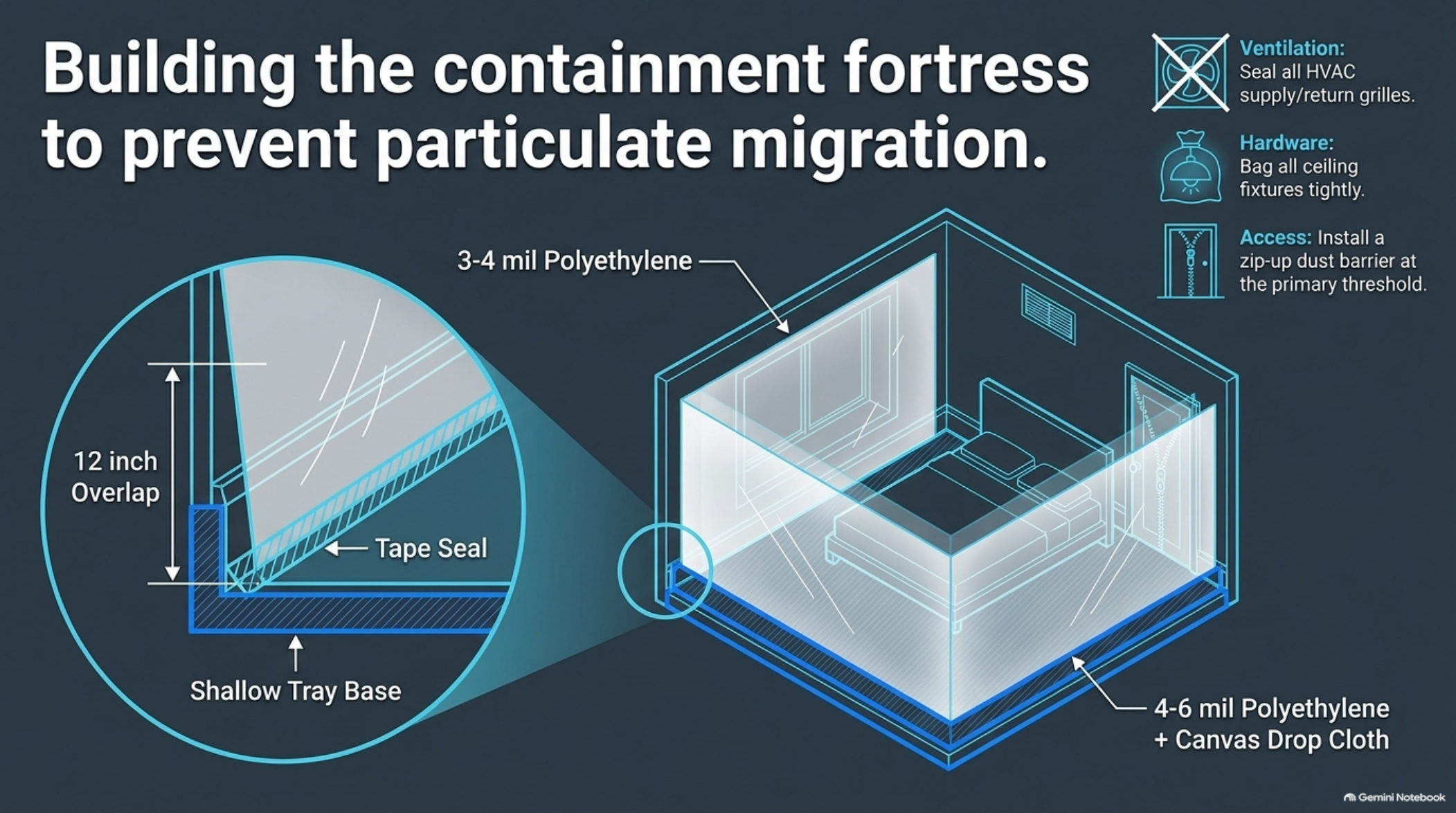
The containment fortress from slide 03 of our Popcorn Extraction Masterclass — how to seal a Cary bedroom, living room, or bonus room before the first pass of the blade.
Every popcorn ceiling job in our masterclass deck starts in the same place: a sealed room. Slide 03, "Building the containment fortress," shows what pros do before the sprayer ever comes out, and it matters just as much in a 1990s Cary townhome as in a pre-1980 Wake County ranch. This post walks the full setup — HVAC grilles, ceiling fixtures, the doorway barrier, and the tray base that keeps wet debris and dust inside the room where it belongs. Skip containment to save an afternoon and you can spend weeks chasing dust out of the rest of the house.
The short version
- Containment comes first because texture removal is a wet job but never a dust-free one, and in pre-1980 Cary homes the texture can carry asbestos.
- Fibers travel by two routes that containment closes: the HVAC system, which pulls fine dust into every room, and the gap under a door, where a half-inch clearance is enough to coat a hallway in powder.
- The first containment step is sealing every HVAC supply and return grille with polyethylene taped at each edge, plus bagging ceiling fans, light fixtures, and smoke detectors tightly rather than draping them.
- A 3–4 mil polyethylene zip-up dust barrier goes at the primary doorway, and wherever two sheets of poly meet they overlap by 12 inches and are tape-sealed along the full length of the seam.
- The floor is built as a shallow tray: canvas drop cloths wall to wall, covered with 4–6 mil poly lapped 12 inches and taped, then run several inches up the baseboards to catch runoff during the wet scrape.
- The room-by-room pre-work checklist takes about an hour for a typical bedroom, and it includes testing a pre-1980 ceiling, clearing the room, turning off the HVAC at the thermostat, and staging tools inside the sealed space.
Why Containment Comes First
Texture removal is a wet job, but it is never a dust-free one. Every scrape pulls down clumps of popcorn, and some of it dries out into fine particulate as you work. In a home built before 1980 — and Cary has plenty, from the early neighborhoods near downtown to older sections along Kildaire Farm Road — that texture can carry asbestos. Federal NESHAP work practices treat any disturbance seriously, and the deck frames it simply: disturbance is the danger. Fibers that are sealed inside the texture are harmless; fibers floating in the air are not.
Those fibers travel by two routes, and containment closes both. The first is the HVAC system, which can pull fine dust through ductwork into every room of the house. The second is the gap under a door — a half-inch clearance is enough to coat a hallway in powder. That is why the deck gives containment its own step, with its own hardware, before the wet-scrape protocol ever begins. A single-room project should never become a whole-house cleanup.
Seal Every Air Path: HVAC Grilles and Ceiling Fixtures
The deck’s first instruction is ventilation: seal all HVAC supply and return grilles. Supply grilles blow air across the work zone, while return grilles actively pull room air — and anything suspended in it — straight into the ductwork. A sheet of polyethylene over each grille, taped at every edge, stops both. Hardware comes next: bag all ceiling fixtures tightly. Ceiling fans, light fixtures, and smoke detectors sit directly in the fall zone of everything you scrape, and every crevice is a dust trap. The deck calls for bags pulled snug and sealed, not draped, so debris slides off instead of collecting on top.
Install the Zip-Up Barrier at the Doorway
With the air paths sealed, the deck moves to access: install a 3–4 mil polyethylene zip-up dust barrier at the primary threshold — the doorway you will actually use. A zip-up barrier seals completely between trips, so dust stays in the room while you step out for water, a blade change, or a phone call, and it closes behind you instead of relying on a drape that blows open. Wherever two sheets of poly meet, overlap them by 12 inches and tape-seal the full length of the seam. That overlap is not arbitrary: it gives the tape a wide, stable bond and leaves a flap that catches dust working its way through the joint.
From our Popcorn Extraction Masterclass deck
Lay the Shallow Tray Base
The floor is the last and largest surface of the fortress, and the deck builds it as a shallow tray: 4–6 mil polyethylene over a canvas drop cloth. Lay the canvas wall to wall first — it cushions the floor and keeps the poly from sliding — then cover it with the 4–6 mil poly, lapping the seams 12 inches and taping them exactly like the walls. Run the poly up the baseboard several inches and tape the top edge. That turned-up lip is what makes it a tray: it catches the water and debris that run down the walls during a wet scrape instead of letting them find the carpet edge. Two layers matter because wet popcorn is heavy and abrasive; a punctured single sheet turns a contained job into a floor repair.
The Room-by-Room Pre-Work Checklist
Run the room through this list before the first sheet goes up. It is the order our vetted pros follow on Cary jobs, and it takes about an hour for a typical bedroom:
- Test before you scrape if the home is pre-1980. A lab sample settles the asbestos question before you build anything — our asbestos testing guide explains how.
- Clear the room. Move furniture out or cluster it in the center under poly, and take down wall art, curtain rods, and switch plates.
- Turn off the HVAC at the thermostat and seal every supply and return grille in the room with taped poly.
- Bag ceiling fixtures tightly — fans, lights, and smoke detectors.
- Hang the zip-up barrier at the primary doorway; tape poly across secondary doors.
- Lay the tray base: canvas drop cloths, then 4–6 mil poly lapped 12 inches and taped, running several inches up the baseboards.
- Stage your tools inside the room — sprayer, blades, HEPA vacuum, wet rags — so nobody has to unzip mid-job.
Once the room is sealed, you are ready for the wet-scrape protocol itself. Keep our containment checklist and supplies calculator open while you shop — it sizes the poly, tape, and drop cloths to your exact room dimensions. And if your Cary home is pre-1980, pair this setup with the asbestos testing guide before you schedule the work.
Popcorn Ceiling Containment FAQ
If my ceiling tests negative, can asbestos still be in the wall dust?
A negative lab result covers the sample you sent — typically the ceiling texture — not every material in the room. In a pre-1980 home, other layers can contain asbestos too, including old joint compound and some textured coatings. The safe habit is to treat all dust the same: keep everything wet, clean with a HEPA vacuum, and wipe surfaces with wet rags. Containment protects you either way, which is why pros build it even after a negative test.
Do I really need full containment in a post-1980 home?
Yes — scaled, but not skipped. A post-1980 ceiling removes the asbestos worry, but wet-scrape debris is still heavy, messy, and dusty, and without a sealed doorway and tray base it migrates through the house on shoes, air currents, and the HVAC system. At minimum, seal the room, tape the grilles, and lay the poly tray. It is the difference between a one-room project and a house-wide cleanup.
What if the room I am scraping has a return-air vent?
Seal it first. A return grille pulls air toward the ductwork, making it the fastest route for dust to reach the rest of the house. Tape poly over the grille, seal every edge, and leave the HVAC system off at the thermostat until the room is cleaned and the plastic comes down. Change the filter afterward even if you sealed well — it is cheap insurance.
Keep moving through the deck: read The Wet Scrape Technique: How Pros Remove Popcorn Without Gouging for the scraping protocol, or Removing Painted Popcorn: The Mud-Roller Workaround for ceilings that have been painted over the years. Need a crew that runs this exact containment process in Cary? Call (984) 228-9926 or get matched with a vetted pro.