Asbestos Waste Disposal After Popcorn Removal: EPA Rules for NC Homeowners
Removing a pre-1980 popcorn ceiling does not end when the last of the texture hits the drop cloth — it ends when the debris is sealed, transported, and buried at a site permitted to take it. Popcorn from that era can carry 1 to 10 percent asbestos, and once it is scraped loose it is regulated waste. The EPA's NESHAP rules govern exactly how that waste must be handled, and they apply to Cary homeowners just as they apply to licensed crews. If you are here looking into popcorn ceiling asbestos test, the sections below walk through the process from the first quote to the finished job.
The Rules Do Not Stop at the Ceiling
Asbestos fibers are harmless while they stay sealed inside the texture and dangerous only when they become airborne. That is the principle behind every rule in the Popcorn Extraction Masterclass, and it is why the disposal protocol exists: wet-scraped debris can dry out and shed fibers, contaminating a truck, a garage, or a landfill tipping floor if it is mishandled.
The short version
- Popcorn ceiling texture from the pre-1980 era can carry 1 to 10 percent asbestos, and once it is scraped loose it becomes regulated waste under the EPA's NESHAP rules.
- The NESHAP disposal protocol is four moves: continual wetting, double bagging in leak-proof bags, CAUTION labeling, and transport to an approved landfill.
- Debris goes into a leak-tight 6-mil polyethylene bag that is sealed, then into a second leak-tight bag sealed again, and bags must not be packed so full that a seam is stressed.
- No Wake County convenience center or transfer station accepts asbestos and household trash pickup cannot take it, so the load must reach a permitted landfill, usually outside the county and almost always by appointment.
- Curbside trash, dumpsters, burn piles, and favors from friends with pickups are all illegal routes, because when a bag meets a compactor it breaks and the hazard moves into the air where sanitation crews work.
- If representative samples test negative and no other suspect material is present the debris is ordinary construction waste, but the lab report should be kept on file because it is what proves the load was not regulated.
Post-extraction debris falls under the National Emission Standards for Hazardous Air Pollutants — NESHAP, in short — which tracks the waste from removal through transport to disposal so there is no secondary airborne contamination along the way. In North Carolina, those federal standards are administered alongside state solid-waste rules, which is where the local requirements come in.
The NESHAP Disposal Protocol, Step by Step
The masterclass boils the protocol down to four moves: continual wetting, double bagging in leak-proof bags, CAUTION labeling, and transport to an approved landfill. Each step keeps the fibers wet and contained from the ceiling to the disposal cell.
Continual wetting. Debris stays wet from the moment it is scraped until the bags are sealed. Mist the pile as you work and re-wet it before bagging — the same wet-method rule that governs the removal applies to the waste. Never let the debris dry out, and never dry-sand or dry-brush it: dry handling is what puts fibers in the air.
Double bagging. Place the wet debris in a leak-tight 6-mil polyethylene bag and seal it, then put that bag inside a second leak-tight bag and seal it again. Each bag gets its own closure — twist, fold, and tape or zip — and bags should not be packed so full that a seam is stressed. If a bag tears, treat it as a leak and re-bag the contents.
CAUTION labels. Every bag carries a warning label identifying the contents as asbestos. The label is not paperwork theater — it tells every handler between your ceiling and the landfill that the bag must stay intact and stay wet.
Transport to an approved landfill. Sealed bags move in a leak-tight vehicle — a closed truck or a covered bed with no loose debris — straight to a disposal site permitted to accept asbestos waste. That is the only legal destination for the load.
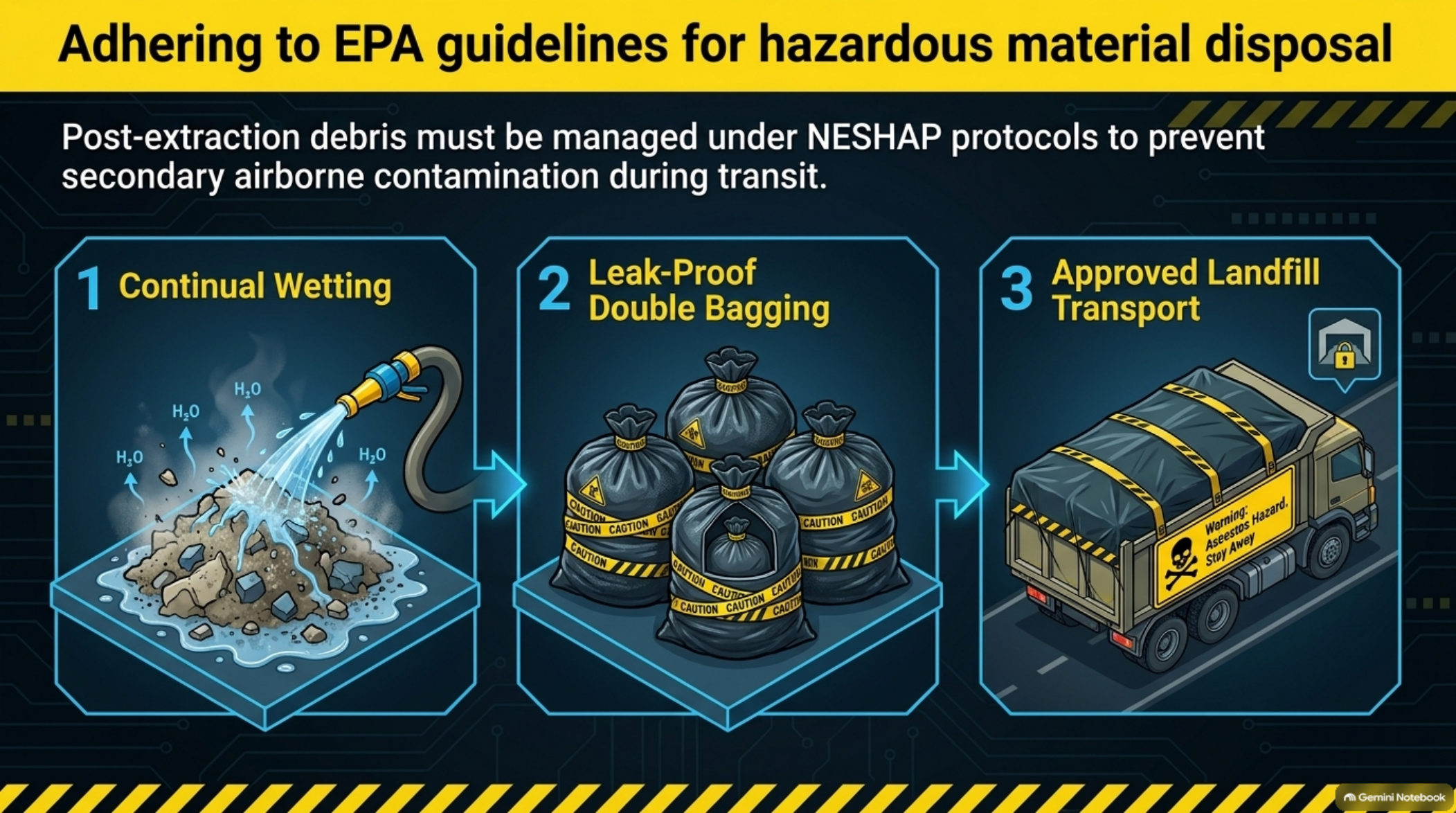
Slide 9 — NESHAP disposal: continual wetting, double bagging, labeling, approved landfill. See the full deck walkthrough.
What Cary and Wake County Homeowners Must Do
If your home is pre-1980 and the texture has never been tested, the first step is not disposal — it is the lab. Our asbestos testing guide walks through sampling so you know exactly what you are handling before anything comes off the ceiling.
If the test comes back positive — or you removed before testing — the debris is asbestos waste and the rules above apply to you personally. The practical hurdle in the Triangle: no Wake County convenience center or transfer station accepts asbestos, and household trash pickup cannot take it either. The load has to reach a landfill whose permit authorizes asbestos disposal — typically a large lined site, often outside Wake County, and almost always by appointment. Call ahead, confirm the site takes homeowner loads, and keep the receipt that proves where the waste went.
That is the gap a licensed abatement crew fills. Professionals working under NESHAP transport the waste in sealed, labeled vehicles; maintain accounts at approved disposal sites; and document the load so you are not the one calling around for a landfill appointment. Every pre-1980 removal our vetted pros run ends with the debris delivered to an approved site — it is part of the process, not an add-on. Estimate bag counts with the asbestos disposal calculator in our toolbox, and run our disposal checklist alongside any crew you consider.
Why Ordinary Trash Pickup Is Illegal for Asbestos Waste
Curbside trash is not a disposal route for asbestos waste, and it is not a gray area. Household garbage goes to transfer stations, compactors, and landfills that are not permitted to accept asbestos. When a bag of wet, labeled asbestos debris meets a compactor, the bag breaks and the hazard moves into the open air where sanitation crews work. NESHAP requires disposal at an approved site, and state solid-waste rules reinforce it — dropping asbestos in the can is illegal disposal, full stop.
The same logic rules out dumpsters, burn piles, and favors from friends with pickup trucks. Regulated waste keeps its status until it is buried at a permitted site, and the paper trail — labels, transport, and a disposal receipt — is what proves it got there. If you cannot produce that trail, the load is still your responsibility.
Frequently Asked Questions
Do I need a licensed hauler to move asbestos waste from my home?
NESHAP does not require a special license for a homeowner moving their own small load, but it does require the waste to reach an approved landfill — and many of those sites only take contractor loads or scheduled appointments. If you self-transport: keep the debris wet, double-bagged, and labeled; carry it in a closed, leak-tight vehicle; drive straight to the approved site; and keep the disposal receipt. For most Cary homeowners, a licensed abatement crew is the simpler path because the transport and documentation come with it.
Which landfills accept asbestos waste in Wake County, NC?
No Wake County-run facility does — not the convenience centers and not the transfer stations. Asbestos goes to landfills whose permits specifically authorize it, generally large lined disposal sites in the region, and loads are scheduled by appointment rather than dropped off casually. Ask your crew which site they use; if you are handling disposal yourself, call sites ahead and confirm they accept homeowner asbestos loads before you drive.
What if my debris tests negative for asbestos?
If representative samples came back negative and no other suspect material is in the job, the debris is ordinary construction waste and can follow normal construction-disposal rules — but keep the lab report on file, because it is what proves the load was not regulated. If you skipped testing and the home predates 1980, treat everything as suspect: wet it, bag it, and dispose of it as asbestos rather than gambling at the landfill.
Disposal is the part of popcorn removal you cannot see from the ceiling — and the part that matters most to your family, your neighbors, and the environment. If hauling regulated debris is not how you want to spend your weekend, get matched with a vetted pro whose process includes approved disposal — or call (984) 228-9926 and we will help you find the right crew in Cary.
Prefer to read the full series? Check the angled-light inspection trick that finishes the ceiling before primer, then go back to the containment setup that keeps asbestos fibers inside the work area in the first place.